
Cabinet refacing in Rockville starts with the kitchen you already have. New doors and drawer fronts can give the room a different character, while matching material covers the exposed cabinet surfaces. The interior boxes usually remain. That makes the condition of those boxes central to the decision.
Look inside the cabinets and beneath the sink before collecting door samples. A useful refacing assessment checks box condition, retained surfaces and how the room works today. Ask the provider to identify the new fronts, covered surfaces and any hardware or interior work included in the proposal.
What changes, and what stays in place
A refacing proposal commonly includes replacement doors and drawer fronts, treatment of exposed face frames, and matching end panels or other visible surfaces. Handles and hinges may change too. Ask for a written surface list: the side beside the refrigerator and the back of a peninsula are easy places to overlook.
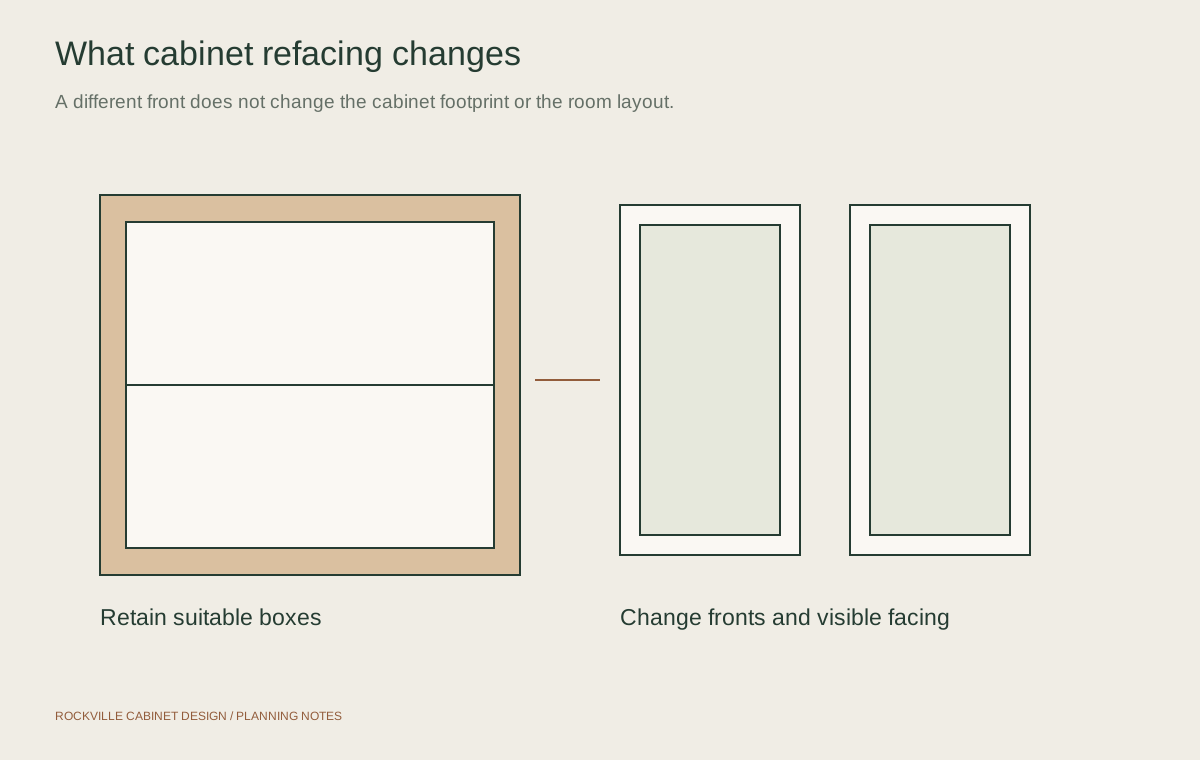
Refacing does not automatically replace drawer boxes, shelves, interiors or the cabinet structure. Those can be separate additions or repairs. It also leaves the basic cabinet arrangement in place, unless the proposal specifically includes alterations. Be clear about which items are new, which are covered and which remain as they are.
Check the boxes and layout before choosing fronts
Open every cabinet, including the one that holds cleaning supplies. Look for swelling, persistent moisture, loose joints, damaged bottoms and attachment problems. A finish change cannot resolve an ongoing leak or make an unsound box dependable. The provider should explain whether damage is local and repairable or makes replacement the better starting point.
Can the existing arrangement support your routine?
Think through an ordinary evening. Can two people pass the dishwasher? Are the everyday pans within reach? Refacing makes sense when the main arrangement already serves you. If your goal is a wider appliance opening, a relocated sink or substantially different drawer storage, compare a replacement layout before committing to new fronts.
Choose the fronts and facing as a complete set
Door style changes the character of a room even when the footprint stays fixed. A flat-center Shaker door has a different outline from an arched raised panel. Slab fronts create another effect. Hold a sample beside the existing countertop and backsplash in your own light; a small screen image will not show the full combination.
Ask what the doors, drawer fronts and exposed coverings are made from, how edges are finished, and what care instructions apply. A color match alone does not describe a system. View a sample corner or edge if available, particularly where a cabinet side meets the face frame. Get the actual product and finish names in the specification.
Use the opportunity to fix everyday annoyances
A door makeover can leave an awkward drawer just as awkward. Identify loose hinges, troublesome slides and inaccessible shelves during the assessment. Some hardware replacements or pull-outs may be practical additions, but each must fit the existing opening, box and door movement. Confirm compatibility before treating a soft-close feature as included.
Handle placement deserves a decision before drilling. Consider how the grip feels, where neighboring doors meet and whether a pull will hit an appliance or wall. If an old drawer box will remain behind a new front, check its condition and usable space. Replacing the face will not increase its interior capacity.
Plan the work around the surfaces you want to keep
Keeping existing countertops and backsplash may be a major reason to choose refacing. Record those retained items in the scope, along with protection and responsibility for accidental damage. Any proposed cabinet alteration beneath an existing surface needs its own assessment. Keeping boxes during a door change differs from removing the supports below a countertop.
Ask how the kitchen will be staged: which pieces leave the house, what preparation happens on site, when doors return, and when drawers can be loaded again. Set aside a place for food and essential cookware. The actual disruption depends on materials, preparation, repairs and the provider's sequence; it should come from that project's plan.
Compare the whole scope before choosing a route
Refacing, painting and replacement solve different problems. Painting changes the finish on suitable existing fronts. Refacing replaces the fronts and treats exposed surfaces while retaining suitable boxes. Replacement provides a route to different box sizes and a new arrangement. The best use of the budget depends on cabinet condition and what you want to change.
For a refacing discussion, bring room photographs, close-ups of damage and a list of cabinets that frustrate you. Request a door-and-drawer count, surface schedule, hardware list, repair allowances, cleanup terms and warranty details. Compare a replacement alternative if the refacing proposal grows to include extensive structural repairs and several new cabinets.
From arched oak doors to warm-white Shaker fronts

The starting point
The starting kitchen has honey-oak doors with arched raised panels, matching drawer fronts and exposed oak ends. Its cabinet arrangement already works, and the pale countertop, neutral backsplash, sink window and appliances are intended to stay.
The proposed work
The proposed work begins with a box and moisture assessment. Suitable boxes would receive warm-white Shaker doors, matching drawer fronts and coordinated facing on exposed frames and ends. Brushed-nickel hardware would be checked against door swings before installation. The cabinet divisions would remain unchanged.
The result to plan for
The planned result changes the door profile, color and visible facing without suggesting that the kitchen grew or the countertop was replaced. Existing interiors would remain unless separate improvements were agreed.
The useful comparison is the scope behind the new fronts: retained boxes, treated surfaces and hardware all need to be specified.
Questions about cabinet refacing
Can cabinet refacing change my kitchen layout?
The main layout usually remains. A provider may propose individual alterations or new cabinets, but those are additional work. If the arrangement itself is the problem, compare replacement and a measured design before choosing refacing.
Will the cabinet interiors look new?
Only if the proposal includes interior work. New doors and matching exterior facing do not renew shelves, bottoms or drawer boxes. Ask the provider to identify the retained interior finish and any planned repairs.
Can I keep my countertops during refacing?
Often the goal is to retain them because the cabinet boxes stay. Their condition, access and any proposed alterations still need checking. Confirm retained surfaces and protection in the scope; do not assume countertop removal or repair is included.
Is refacing always less expensive than new cabinets?
No universal price comparison fits every kitchen. Door materials, exposed surfaces, repairs and hardware change the scope. Compare written proposals that describe the same desired result, and include a replacement option if substantial box repairs are needed.