
Stock, semi-custom and custom describe different levels of product flexibility. They do not tell you everything about the box, doors, hardware or installation. The boundaries also vary between suppliers, so ask what the actual cabinet line allows rather than relying on its category name.
Start with the parts of the plan that are difficult to fit: a narrow wall, an odd-depth alcove or a cabinet beside a doorway. Then compare the available products against those dimensions. You may need extra flexibility in one location while catalog units work well across the rest of the room.
What changes between the three categories?
Each category gives you a different starting point for the order. A stock line begins with a defined catalog. A semi-custom line adds selected changes to a catalog. A custom order can begin with the dimensions and details of the project, within the maker's capabilities. None removes the need for a careful cabinet schedule.
| Category | What to investigate | A useful fit when |
|---|---|---|
| Stock | Available sizes, door styles, finishes and matching accessories | Catalog units suit the room and the remaining spaces can be finished properly. |
| Semi-custom | Which dimensional changes, interiors and finish options the line permits | A largely standard layout needs a few specific modifications. |
| Custom | Made-to-order dimensions, construction details and finish development | A measured fit or particular design requirement cannot be resolved through the catalog. |
Stock cabinets: test the whole run, including the ends
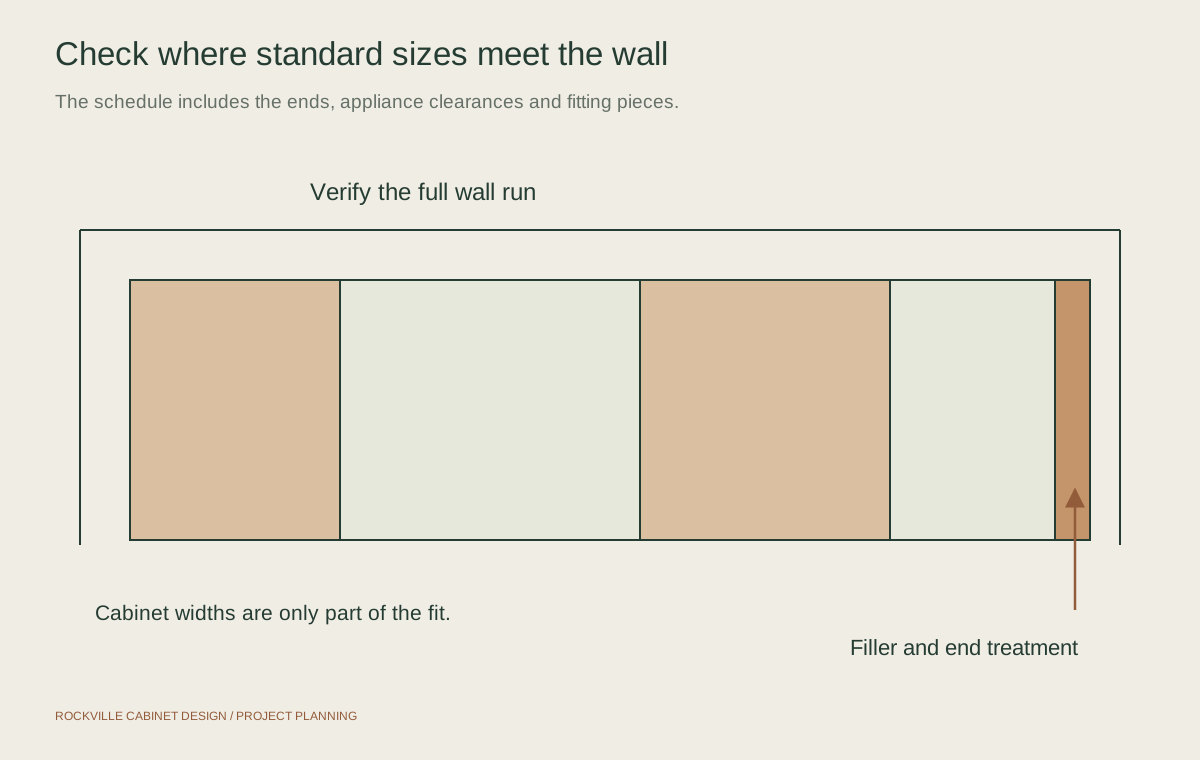
Start by placing the available units on a measured plan. Include the sink base, appliances, corners, panels and spaces needed for doors to open. Adding the cabinet widths alone does not establish that the installation will work. A wall that is out of square or a handle beside an appliance can change the fit.
Fillers are part of cabinet planning. They can provide door clearance or help finish a run against an uneven wall. The question is how much space they occupy and what they accomplish. A modest clearance strip may be sensible; a large unused gap may justify another cabinet arrangement or a modified unit.
A stock line can be a good match for a straightforward layout when the door and finish choices suit the room. Check that the order includes compatible finished sides, toe kicks and other visible details. Availability of the main boxes does not establish availability of every matching piece.
Semi-custom cabinets: name the modification
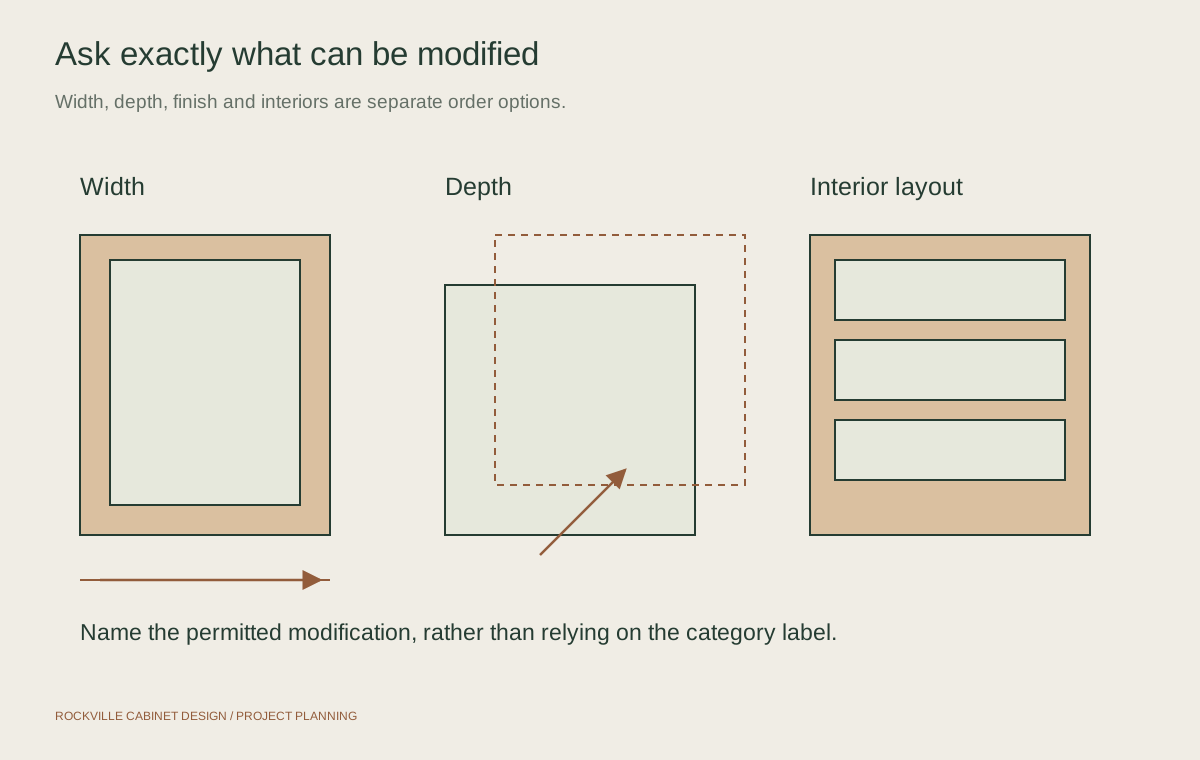
Ask for a list of permitted changes. A line might offer selected depth changes, alternate interiors or additional finish choices while retaining fixed limits elsewhere. Another line may allow a different set of adjustments. The word semi-custom does not promise that every dimension or detail can change.
Consider a kitchen where standard base cabinets work along the main wall but a shallow section is needed beside a doorway. A permitted depth modification could solve that particular problem. The drawer hardware, interior capacity and countertop edge still need coordination; reducing the outside depth does not preserve all the original storage.
Mark each modification on the cabinet schedule and corresponding elevation. Review how it affects the interior, exposed surfaces and adjoining units. If the proposal lists only a cabinet code with a verbal promise to alter it, ask for the change to be written into the approved order.
Custom cabinets: identify the detail that needs to change
Custom cabinetry is useful when the room or storage task calls for something specific: an unusual alcove, a shallow built-in, a particular door proportion or a carefully matched finish. Identify that requirement first. It gives you a reason to choose a made-to-order approach and a clear detail to review in the drawings.
The work still has limits. Appliance ventilation, hardware movement, material behavior and installation access have to be respected. A very large cabinet may suit an elevation but fail to pass through the delivery route. Discuss assembled dimensions and the installation method before approving it.
Ask what custom means for this provider. Confirm the construction specification, door source, finish process and which work happens in the shop or on site. A custom label alone does not establish solid-wood boxes, a particular joinery method or a better warranty. Those are separate details to specify.
Keep construction and assembly separate from the category
Compare box materials, door construction, drawer boxes, hinges and slides within the actual products under consideration. Face-frame and frameless construction are also separate choices. A catalog line may offer construction that meets your needs, while a made-to-order product still needs its specifications examined.
Ready-to-assemble, or RTA, describes how the cabinet is supplied for assembly. It is not a fourth level of customization. Establish who assembles the boxes, checks the parts and accepts responsibility for the finished installation. An assembled product also needs receiving inspection and adjustment after fitting.
Look at samples under useful conditions
View a physical door sample beside your flooring and countertop choices. Check it in the kitchen's daylight and evening light. For wood finishes, discuss the expected variation between pieces; a small sample cannot represent every grain pattern. Keep the approved finish identification with the order.
Approve a cabinet list, not a category label
Once a category fits the project, compare the proposed cabinet schedules. A change from doors and shelves to wide drawers can alter the specification more than the category name suggests. Check the same storage arrangement, visible panels and hardware before drawing conclusions from the totals.
Ask for current product availability and the sequence from approval to delivery. Ordering expectations vary by product and selected options. Confirm how substitutions or later changes are handled, and avoid scheduling removal around an unconfirmed arrival assumption.
- Verify cabinet codes, dimensions and every approved modification.
- Check door style, material, finish and the treatment of exposed ends.
- Trace drawers, doors and appliances through their full movement.
- Identify fillers, panels, trim, handles and interior accessories.
- Record responsibility for final measurement, assembly, delivery and installation.
Questions about stock, semi-custom & custom cabinets
Are custom cabinets always better than stock cabinets?
Custom cabinets offer flexibility that can solve particular fit or design problems. That does not establish better construction or a better match for every project. Compare the actual materials, hardware, finish and layout. If a stock line meets those needs and fits properly, the custom flexibility may add little practical value.
Can semi-custom cabinets be made in any size?
Do not assume unlimited sizing. Each line defines which changes it accepts and how those changes affect the cabinet. Ask about the exact width, height or depth adjustment you need, then review its effect on the interior and neighboring units in the approved drawings.
Does RTA mean the cabinets are stock?
RTA means ready to assemble. It describes the delivery and assembly format rather than fully describing the available sizes, materials or design options. Read the product specification and confirm who handles assembly, missing parts and installation before comparing it with an assembled cabinet proposal.
Can I mix stock and custom cabinets in one kitchen?
It may be possible, but check the details before ordering. Door proportions, finish, cabinet depth, toe-kick height and hardware can differ between sources. A separate custom unit should solve a defined need, with the designer and installer agreeing how the adjoining pieces will fit and look together.