
Have the property address, an existing-room sketch and a list of proposed changes ready when you contact the permit office. City of Rockville guidance and Montgomery County's permit handout provide starting points, but the handout excludes municipal and HOA rules. The responsible authority must confirm what applies to the address and work you describe.
Keep approvals on the project list alongside ordering and installation. Ask the business taking on the work which applications and inspections it will handle, and record any responsibilities left with you or another trade. An initial cabinet estimate may leave those arrangements undecided.
A Rockville mailing address does not establish city jurisdiction
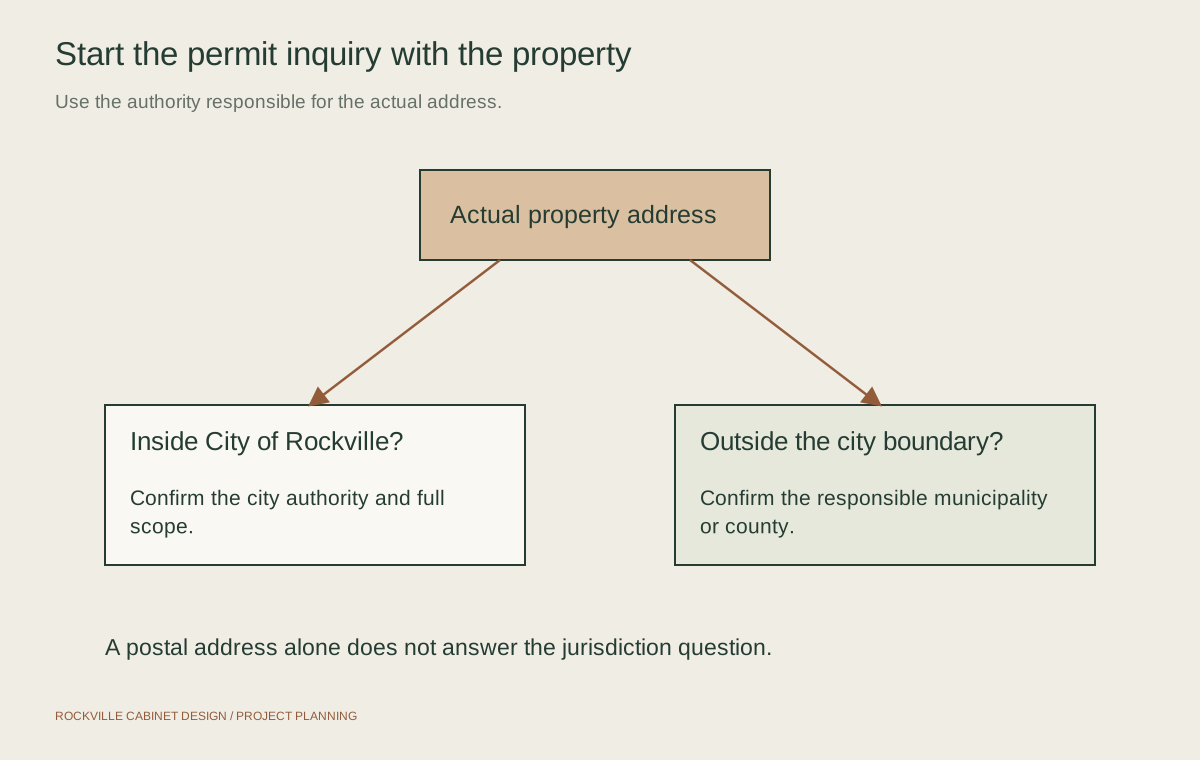
The City explicitly distinguishes a Rockville postal address from a property within its municipal limits. Start with the City's address check rather than relying on the ZIP code, the neighborhood name or the city printed on an old delivery label. Save the result with your project notes.
If the property is outside the City, identify the authority responsible for that particular location. Nearby communities and municipalities should not be folded into one Rockville rule. A contractor who recently worked at another Rockville mailing address may have dealt with a different jurisdiction.
Give the authority the property address and a plain description of the proposed work. If the scope changes later, ask again about the changed part. Keeping the original sink location, for instance, is a different description from relocating the sink after the layout review.
Separate cabinet work from changes around the cabinets
City guidance identifies permit and inspection requirements for certain electrical, plumbing, mechanical and structural work. That makes a complete scope more useful than the phrase kitchen remodel. Include the work behind, above and beneath the new cabinets, even when a different business will perform it.
Montgomery County's handout lists installing, repairing and replacing cabinets among activities that most likely do not require a permit. It also identifies electrical work and interior alterations among activities likely to require one. The handout excludes municipal and HOA rules. It cannot establish an exemption for a property inside Rockville.
Use the distinctions below when describing the work to the permit office. Identify what stays as carefully as what changes. Reusing a countertop does not resolve a separate question about new wiring or a relocated drain.
| Proposed work | What to explain when checking requirements |
|---|---|
| Cabinets or fronts only | Identify replacement, refacing or finish work and confirm whether utilities or walls are affected. |
| Lighting, outlets or appliances | Describe the actual electrical changes, including any new or relocated equipment. |
| Sink or other plumbing changes | State which fixtures, supply lines or drains would move or be altered. |
| Wall, opening or ventilation changes | Explain demolition, structural questions and any exterior door, window or vent changes. |
Prepare a short scope record before making the inquiry
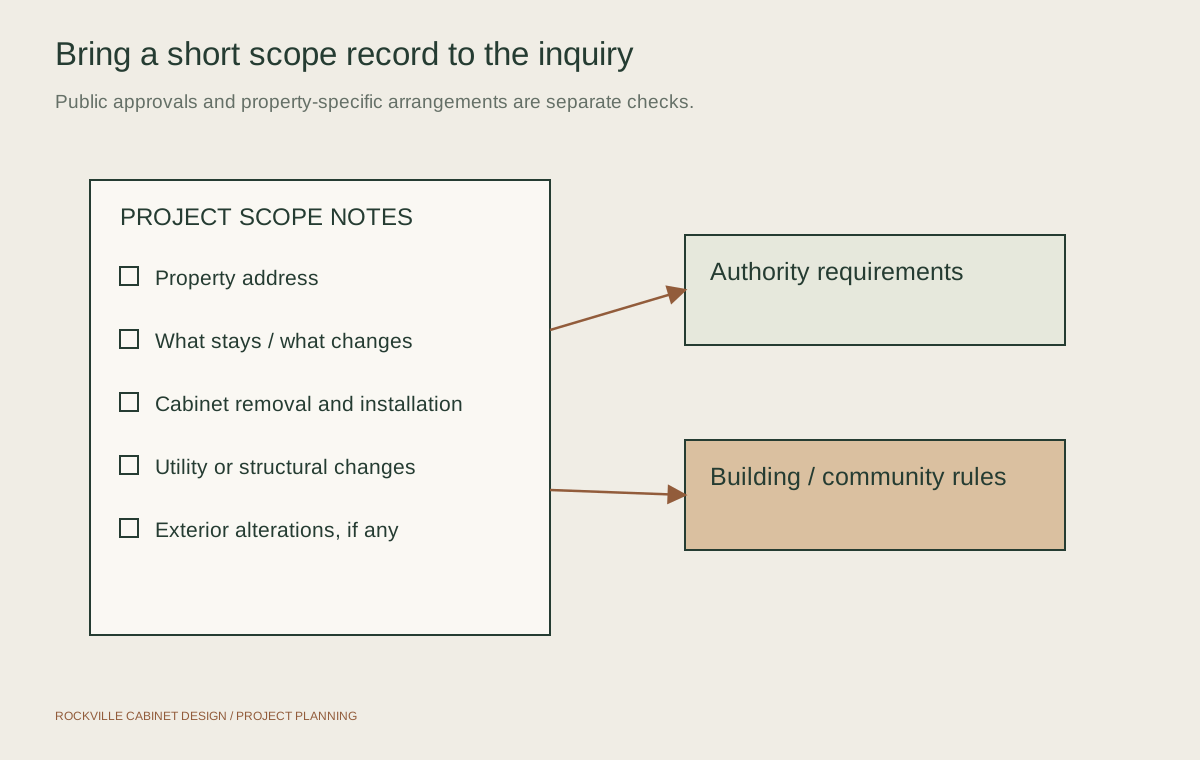
You do not need a polished presentation to explain the project. A clear existing-room sketch, proposed layout and photographs can help the authority understand the question. Ask what drawings or other documents are needed for its process instead of assuming a cabinet sales plan will be sufficient.
List the cabinets, surfaces, appliances and utilities separately. Mark items staying in place, being replaced in place and being moved. Identify any wall removal, new opening or exterior work. If one part is still undecided, say so; a conditional answer based on the current plan may not cover a later change.
Keep written correspondence and the plans it refers to together. A note that simply says no permit needed, detached from the address and described work, is difficult to use when another person joins the project. Record the date, contact and scope behind the response.
- Property address and confirmed jurisdiction
- Existing and proposed cabinet layout with affected appliances
- Electrical, plumbing, mechanical and structural work being considered
- Any exterior opening or ventilation changes
- Questions about applications, inspections and required documentation
Check historic-property questions against the actual alteration
An older house or a West End address does not, by itself, show that an ordinary interior cabinet replacement requires historic review. The cited City historic-property guidance concerns exterior alterations. Establish the property's status and explain the affected elements before drawing a conclusion.
A kitchen project can reach the exterior when it changes a window, door or vent. Those choices deserve a separate inquiry about applicable historic review. A Certificate of Approval and a building permit are separate approvals; one should not be assumed to settle the other.
Raise this early if the cabinet plan depends on changing an opening. It is easier to reconsider an elevation before ordering fitted cabinetry than after the cabinet sizes have been committed. The right sequence comes from the authority's response to your proposed work.
Keep building and community approvals on a separate list
Municipal approval does not answer every question for a condominium or association-managed property. Ask management which governing documents and procedures apply to the unit and the proposed work. Requirements vary by property; another building's elevator arrangement or contractor paperwork is not proof of yours.
Useful questions include delivery and removal access, work hours, common-area protection, utility shutoffs, elevator reservations and contractor documentation. Check where cabinets can be staged without blocking shared space. These arrangements can affect the cabinet delivery plan even when they are not permit matters.
King Farm's published home-improvement guidance distinguishes community review from City permits. Use that distinction as a reminder to check both routes when relevant, rather than assuming every property in the neighborhood has the same rules. Our condo planning guide covers access and delivery in more detail.
Agree on applications and inspections before work starts
Once the authority identifies what is required, establish who handles each application, document and inspection. Put those responsibilities in the agreement with the business accepting the work. If cabinet installation and related trades are separate contracts, identify who coordinates their sequence.
The City's cited guidance directs applicants to MGO Connect. Use the current official instructions when preparing an application, and ask how approval and inspection steps affect the planned work. An estimate, an application submission and an issued approval are different project milestones.
Before demolition, make sure the approved scope, cabinet layout and trade plans describe the same project. If a proposed change affects permitted work, confirm how it should be handled before proceeding. Keep the final documents and relevant inspection records with the product information and provider agreements.
Questions about rockville kitchen permits
Do I need a permit just to replace kitchen cabinets in Rockville?
Confirm the address and complete scope with the responsible authority. The County handout describes cabinet work as most likely not requiring a permit, but excludes municipal and HOA rules. It cannot establish an exemption inside the City or resolve related electrical, plumbing or structural work.
Can my ZIP code tell me which permit office to use?
Use the City's address check. A Rockville mailing address can be outside the municipal limits, so the postal city and ZIP code alone do not establish the authority responsible for the property.
Does an older West End house automatically need historic review for new cabinets?
Do not assume that from the neighborhood name or age. Check the property's status and the actual alteration. The cited City guidance addresses exterior changes; a new kitchen window or exterior vent raises a different question from ordinary interior cabinetry.
Does a City permit replace condo or HOA approval?
Treat them as separate processes. Ask the property's management or association what applies to your unit and scope. Community approval also does not establish that the relevant municipal permit questions have been settled.